
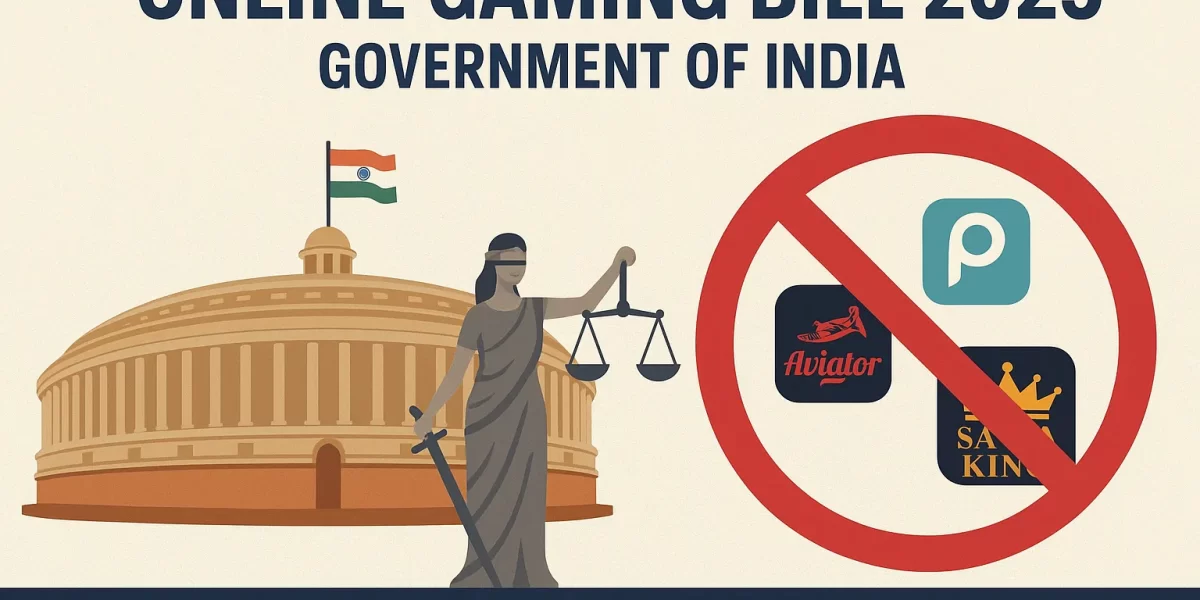
1. The Digital Game That Grabbed the Nation
In the age of smartphones and cheap data, online gaming transformed from a casual pastime into one of India’s biggest digital revolutions. Fantasy cricket leagues, poker tournaments, and rummy apps became household names. With slogans like “test your skill,” “play with friends,” and “win real money,” platforms such as Dream11, MPL, RummyCircle, and WinZO turned into mainstream entertainment.
By 2024, India had nearly 488 million online gamers, with about 155 million engaged in real-money gaming (RMG). This created a booming $2.7 billion industry, where 83–86% of revenue came from RMG formats. For many, it was more than play—it was aspiration, income, and identity.
But 2025 brought a reset button. The Online Gaming Bill 2025 was introduced, aiming to encourage e-sports and social gaming but ban online real-money gaming in India. The move was both a protection measure and a cultural earthquake.
2. The Online Gaming Bill 2025: Game Over or Level Up?
The Bill defines an “online money game” as any digital game—whether of skill or chance—where a player stakes money or hopes for monetary gain. Its main provisions include:
Offering, facilitating, or advertising such games is prohibited.
Banks and payment processors cannot handle gaming-related transactions.
Penalties include 3–5 years in jail and fines up to ₹2 crore.
A central Authority will regulate, approve, or reject games—officially endorsing e-sports and subscription-based educational/social games.
Although promoted as balanced regulation, the reality is stark: online real-money gaming in India is effectively outlawed. With no legal payment routes, companies like Dream11 and MPL face a dead end. For the industry, it feels like the lights went out mid-game.
3. Impact of Online Gaming Ban on Indian Economy
Economically, numbers tell a big part of the story:
India’s GDP stands at about $4 trillion. While online gaming contributed only 0.06–0.08% directly, the ripple effect of the ban is massive.
The government collected nearly ₹15,000–20,000 crore in taxes annually from RMG—thanks to the 28% GST on deposits and 30% TDS on winnings. That stream now risks drying up.
Jobs and FDI are under threat. Industry leaders warn of 200,000 job losses, reduced foreign investment, and a shrinking of the sector’s projected $25 billion valuation.
So while the direct GDP contribution was small, the impact of the online gaming ban on economy stretches far beyond simple numbers.
Jobs, Startups, and FDI Losses
The sudden restriction has paralyzed startups, esports teams, content creators, and gaming developers. The online gaming jobs and FDI impact could derail the startup ecosystem that had thrived on funding and sponsorships.
Tax Revenue Fallout and Government Collections
From Dream11’s massive tax contributions to MPL’s compliance with GST, the state benefited from this ecosystem. But with the ban, collections vanish while the black market risks growing unchecked.
4. From Dream11 to Empty Chairs: Platforms Facing the Ban
The ban hits home for millions of players and popular platforms:
Dream11 ban 2025 headlines shook fans—it had over 200 million users.
MPL, with nearly 90 million users, now struggles to survive.
Games24x7, WinZO, and Poker platforms are staring at shutdowns.
Even before the Bill, platforms were struggling. Spartan Poker laid off 125 staff, while GetMega shut down entirely. Between 2022–25, regulators blocked 1,400+ betting portals. Now, the Online Gaming Bill 2025 is the final nail.
For most companies, survival options are limited—pivot to subscriptions, exit India, or face closure.
5. Youth, Addiction, and the Real Cost of Online Gaming
For India’s youth, online games were more than fun—they were aspiration. Students built fantasy teams, strategized, and even earned pocket money. But the flip side is alarming:
Many users, especially teenagers, spent 13+ hours weekly on money games.
Stories of online gaming addiction in India abound, where players fall into financial traps and mental health struggles.
The Bill cites psychological harm, predatory designs, and bot manipulations—real risks faced by countless families.
Banning RMG may reduce harm but could also drive players toward illegal, unregulated black-market betting apps, making the problem worse.
The Rise of Online Gaming Addiction in India
Addiction rates among young players increased drastically between 2020–2024. Families reported debt, anxiety, and disrupted education. This was one of the government’s strongest arguments for prohibition.
The Risk of Black-Market Gaming Apps
Experts warn that the underground market may expand post-ban. Without legal alternatives, players might migrate to unsafe apps without consumer protections.
6. Social Costs Beyond Revenue Loss
This debate isn’t just about money. The Online Gaming Bill 2025 reflects larger social concerns:
Mental health and safety: Addiction, family disputes, and financial distress were growing.
Community impact: Platforms like MPL created esports streaming careers, coaching jobs, and digital communities—now at risk.
Trust deficit: Parents and regulators demanded stronger protections. The government’s answer was prohibition.
In short, the ban may protect individuals, but it also dismantles a thriving ecosystem of creators, gamers, and entrepreneurs.
7. Future of E-sports in India After the Ban
If real-money games vanish, where does India’s digital play culture go?
The Bill encourages future of e-sports in India, social gaming, and subscription-based educational platforms. The government and private investors are expected to focus on:
Regional e-sports hubs and training centers.
Career pathways for professional gamers and streamers.
Safe online gaming alternatives for skill development and entertainment.
But the big question remains: Can e-sports grow fast enough to fill the vacuum left by RMG?
Government Push Towards E-sports Growth
With bans on RMG, resources may flow toward official tournaments, infrastructure, and school/college-level e-sports programs.
Regional Gaming Hubs and Career Opportunities
Cities like Bengaluru, Hyderabad, and Pune could emerge as India’s e-sports capitals, offering both entertainment and employment opportunities.
8. Safe Online Gaming Alternatives and Balanced Regulation
Instead of a full ban, experts suggest a middle ground:
Tighter regulations instead of prohibition
Age verification, time caps, and self-exclusion features.
Clear distinction between skill-based games and gambling.
Transparent practices
Platforms disclosing win-loss ratios and house margins.
Player protection
Mental health support lines like KIRAN (1800-599-0019) and Tele-MANAS (14416) integrated into apps.
By promoting safe online gaming alternatives, India could balance aspiration with protection.
9. Final Reset: Is the Online Gaming Bill 2025 the End or a New Beginning?
The Online Gaming Bill 2025 has flipped the switch on India’s booming RMG market. For platforms like Dream11 and MPL, it’s a collapse; for gamers, it’s a forced transition.
The critical question: Does banning online real-money gaming in India solve the problem—or just shift it underground?
The answer lies in whether we invest in healthy e-sports infrastructure, safe gaming alternatives, and balanced regulation. If we get it right, this could be a new beginning. If not, India may face a surge in black-market betting and lost opportunities.
In the end, society must decide: Do we press Continue on a safer digital model—or accept Game Over?